Relocation friction is the silent killer of talent momentum.
When a new hire, resident, or intern signs an offer letter, the clock starts.
The goal is not just to get them to Atlanta.
The goal is to get them productive.
Yet, many organizations treat the transition between "hired" and "housed" as a secondary detail.
In reality, housing is the primary bottleneck in the onboarding pipeline.
In a high-velocity market like Atlanta, a lack of structure in apartment placement doesn't just frustrate the candidate.
It creates operational drag.
It creates onboarding delays.
It creates a "hidden cost" that your HR department pays in wasted man-hours and lost efficiency.
Here are the seven most common mistakes slowing down your Atlanta placements.
1. Treating Housing as a Variable, Not a Constant
Most relocation strategies leave the apartment search to chance.
They provide a lump sum or a list of links and hope for the best.
Hope is not an operational strategy.
When housing is treated as a variable, the timeline becomes unpredictable.
One candidate finds a unit in three days; another takes three weeks.
This inconsistency prevents you from standardizing your start dates.
The goal is not to offer a perk.
The goal is to build a repeatable housing infrastructure.
2. Delegating Search Velocity to the Candidate

Asking a new hire to navigate the Atlanta rental market is an efficiency leak.
Atlanta's market moves with incredible velocity.
Units listed on Monday are often leased by Wednesday.
When candidates manage their own search, they often move too slowly.
They lack the data to know which properties meet their specific commute and lifestyle needs.
They spend their first two weeks at work distracted by lease applications and tour schedules.
The goal is not to give them "freedom."
The goal is to provide clarity and leverage.
By taking the search off the candidate's plate, you protect their focus.
You ensure they hit the ground running.
3. The "Wasted Tour" Efficiency Leak
There is a significant difference between a tour and a productive tour.
Candidates often waste days visiting properties that don't fit their criteria.
They get caught in "analysis paralysis" because they are viewing too many irrelevant options.
Every wasted tour is a wasted hour of your company’s time.
A structured placement system filters these options before the candidate ever arrives in Atlanta.
It matches the candidate with vetted, relevant properties based on real-time data.
This reduces the "decision fatigue" that often causes onboarding delays.
4. Inconsistent Support Across Different Tiers

Many organizations offer robust support for executives but leave interns and residents to fend for themselves.
This creates a fragmented relocation experience.
The friction for a medical resident or a summer intern is just as high as it is for a VP.
If your interns are struggling to find housing, your program’s reputation suffers.
If your medical residents are late for orientation because of a lease issue, your operations are compromised.
A standardized housing workflow should apply to every person you relocate.
It ensures that decision fatigue is minimized across the board.
5. Failing to Standardize the Vetting Process
Not every apartment community in Atlanta is built for the professional tenant.
Some have cumbersome application processes.
Others have inconsistent management standards.
Without a centralized vetting process, your HR team has no visibility into where your talent is living.
This leads to "housing-related friction" that spills over into the workplace.
A structured placement system vets properties for you.
It looks for professional management, efficient lease execution, and reliable timelines.
It moves from a "scattered" approach to a "standardized" one.
6. Ignoring the Hidden Cost of Onboarding Delays

What is the cost of a one-week delay in a new hire’s start date?
Multiply that by 50 hires a year.
The number is staggering.
Most of these delays are housing-related.
A lease doesn't get signed in time.
A move-in date gets pushed back.
The candidate is living out of a suitcase and isn't mentally present.
The goal is not just to find an apartment.
The goal is to eliminate the friction that causes these delays.
You need a system that aligns the housing timeline with the employment timeline.
7. Absence of a Central Placement Infrastructure
Relocation is often handled in silos.
HR handles the offer.
The candidate handles the search.
The department head handles the start date.
This lack of central infrastructure leads to a communication breakdown.
Nobody knows exactly where the candidate is in the housing process until there is a problem.
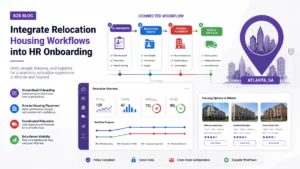
Apartment Deal Hub acts as that central infrastructure.
We provide the coordination, matching, and sourcing required to make relocation seamless.
We are not just "locators."
We are an extension of your recruitment and onboarding team.
From Friction to Momentum
Relocation housing should not be a headache for your HR department.
It should be a standardized, automated part of your talent acquisition strategy.
When you move from a manual, candidate-led search to a structured placement system, everything changes.
Timelines become clear.
Efficiency increases.
Friction disappears.
The goal is not to find a place to live.
The goal is to get your talent to work.
Need a more structured way to support Atlanta-bound employees, interns, residents, or fellows? Start a relocation housing request with Apartment Deal Hub. Visit us at ApartmentDealHub.com.