Relocation is not just a logistical move.
It is a transition of momentum.
For HR departments and staffing agencies, that momentum is often lost in the "black hole" of the housing search.
A candidate signs the offer letter. The excitement is high.
Then, they spend the next three weeks scouring Zillow, getting ghosted by property managers, and stressing over Atlanta’s complex commute patterns.
The goal is not just to get the employee to Atlanta.
The goal is to get the employee operational in Atlanta.
Most companies underestimate the friction of the apartment search.
They view housing as a personal problem for the employee to solve.
But in reality, housing friction is a business cost.
Every hour your new hire spends researching Buckhead versus Midtown is an hour they aren't focusing on their onboarding.
Every day their start date is delayed due to "housing complications" is a day of lost productivity.
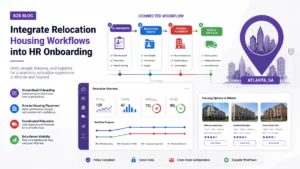
This guide provides the framework for turning Atlanta apartment relocation from a chaotic variable into a standardized business workflow.
The Atlanta Paradox: Growth vs. Friction
Atlanta is a corporate magnet.
In 2026, the city continues to attract global HQs, from tech expansions in Midtown to manufacturing hubs in Cobb County.
The market is stable, inventory is rising, and conditions are becoming more "buyer-friendly."
But for a relocating professional, this creates a paradox.
More choice does not mean an easier choice.
More choice often leads to decision fatigue.

The "hidden cost" of the Atlanta market is its segmentation.
A "good deal" in one neighborhood might mean a 90-minute commute to the office.
A "luxury" building on paper might be located in a construction zone that makes professional focus impossible.
When HR teams tell employees to "just find a place," they are essentially asking them to navigate a high-stakes real estate market without a map.
The result is almost always a hidden cost to the company.
Beyond the "List": Why Manual Housing Support Fails
Many HR departments attempt to solve this by maintaining a "preferred apartment list."
On the surface, this looks like support.
In practice, it is a liability.
The housing market moves faster than an HR spreadsheet.
Pricing changes daily. Availability shifts by the hour.
A list created in January is obsolete by February.
Furthermore, a list provides data but no insight.
A list cannot tell a new hire that a specific floor plan in Midtown has noise issues.
A list cannot explain why a commute from Sandy Springs to the Perimeter is different than a commute from Sandy Springs to Buckhead.
The goal is not to give employees more data.
The goal is to give them clarity.
When employees are overwhelmed with information, they freeze.
This housing-related decision fatigue is what causes candidates to second-guess their relocation.
It creates a "wait and see" mentality that slows down the entire talent pipeline.
Standardizing the Staffing Agency Pipeline
For staffing agencies, the stakes are even higher.
You are in the business of placement.
If a candidate cannot find housing, the placement is at risk.
Staffing agencies often find themselves acting as unpaid, unlicensed relocation consultants.
Recruiters spend their time answering questions about "safe neighborhoods" and "average rents" instead of finding new talent.

The solution is not to do more work.
The solution is to outsource the friction.
By implementing a standardized housing support system, staffing firms can:
- Protect their placement revenue.
- Reduce the "time-to-fill" for out-of-state roles.
- Improve the candidate experience without increasing internal labor.
It is about leverage.
You leverage local real estate expertise to handle the housing, so your recruiters can focus on the talent.
Interns and Residents: The Logistics of Scale
High-volume relocation: such as intern programs, medical residencies, or fellowships: presents a unique logistical challenge.
You aren't moving one person; you are moving fifty.
The friction is not just individual; it is systemic.
If fifty interns arrive at once and none of them have housing, the HR department becomes a housing crisis center.

These programs need more than just a list of apartments.
They need structure and coordination.
They need a centralized hub that can manage high-volume matching and tour coordination.
Standardizing housing for these groups does not just help the participants.
It protects the reputation of the program.
A smooth housing experience is a competitive advantage in the war for top-tier intern and resident talent.
The ROI of a Structured Housing Workflow
Relocation housing should be treated like any other business process: it should be measurable, repeatable, and efficient.
When you move from a "self-search" model to a "structured placement" model, the ROI is immediate.
You see it in fewer housing-related delays.
You see it in higher candidate "show-up" rates.
You see it in the mental bandwidth your HR team gets back.

A structured approach to housing is not a "perk."
It is a strategic infrastructure.
It is about recognizing that the "last mile" of recruitment is the move itself.
If the last mile is broken, the entire journey was a waste of resources.
How to Implement a Professional Housing Workflow
To succeed in the 2026 Atlanta market, HR teams must move away from being information providers and toward being process enablers.
- Acknowledge the friction. Stop assuming housing is easy just because the market is "buyer-friendly."
- Audit your current support. Is your team spending hours on housing questions? If so, your process is leaking money.
- Bridge the insight gap. Provide candidates with experts who know the nuances of Atlanta commute patterns and neighborhood dynamics.
- Standardize the hand-off. Create a clear protocol for when a candidate is handed off to a housing partner.
Conclusion: Focus on the Talent, Not the Apartment
The ultimate goal of every HR professional and staffing agent is to build a high-performing team.
That team cannot perform if they are stressed about where they are going to live.
At Apartment Deal Hub, we function as the "housing department" you didn't know you needed.
We provide the verified research, location-informed matching, and tour coordination required to move professionals into Atlanta with zero friction.
We don't just find apartments.
We protect your talent pipeline.
All services are provided at no cost to the employer or the employee.
Our goal is to remove the housing variable from your relocation equation entirely.
Ready to standardize your Atlanta relocation housing?
Visit ApartmentDealHub.com to learn how we can support your HR team or staffing agency today.